
Boost Agency Retention 24% with Pre-Qualified Lender Leads
Discover how lead gen agencies can achieve 24% higher client retention by delivering pre-qualified leads, reducing CPL and increasing lender ROAS in 2026.
Quick answer
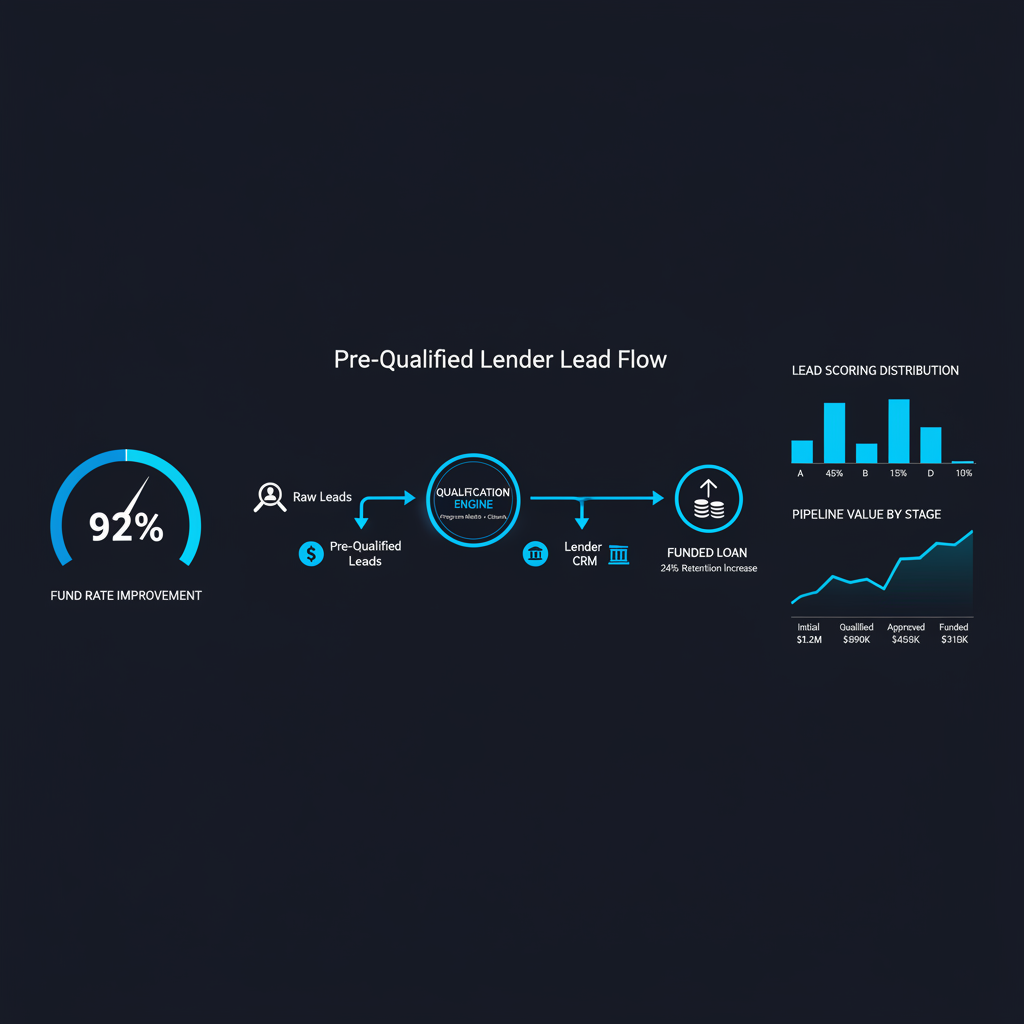
Lead generation agencies can increase client retention by an average of 24% by supplying lenders with pre-qualified leads that match specific program criteria. This strategy reduces wasted sales efforts and improves the lender's lead-to-funded-loan conversion rate, directly boosting their return on ad spend (ROAS) and mitigating common 'blame the lead gen' complaints.
Key takeaways
- Pre-qualification reduces client churn by an average of 24% by delivering higher quality leads that convert to funded loans.
- Lender clients see 15-30% higher ROAS when receiving pre-qualified leads, directly impacting their bottom line.
- Agencies can command 10-25% higher CPL or shift to performance-based models (CPF) with pre-qualified leads.
- Real-time program matching ensures leads meet specific lender criteria, minimizing 'DNQ' rates.
- Implementing pre-qualification technology reduces wasted sales efforts for lenders by up to 50%.
- Compliance with FCRA and state regulations is critical when handling consumer credit data during pre-qualification.
Retaining Clients: Critical for Agency Profitability
Client retention is directly correlated with agency profitability. For lead generation agencies, a 5% increase in client retention can boost profits by 25% to 95%, according to Bain & Company research. However, agencies often struggle with churn, particularly in the lender vertical, where 'blame the lead gen' is a common complaint. This occurs because the standard lead generation model prioritizes volume over explicit qualification for specific lender products.
The primary challenge is delivering leads that don't just express interest but are genuinely *fundable* under a lender's specific and often complex program criteria. Without this crucial step, lenders receive a high volume of leads, but a significant portion will be 'Does Not Qualify' (DNQ) for their core offerings. This leads to wasted sales team time, frustration, and ultimately, a canceled contract.
Imagine an agency with 10 clients. If 3 clients churn annually due to lead quality issues, the agency loses 30% of its recurring revenue. Acquiring a new client can cost 5 to 25 times more than retaining an existing one. This means a focus on retention isn't merely good customer service; it's a financial imperative for sustainable agency growth and reducing client acquisition costs.
Optimizing for client retention fundamentally shifts an agency's focus from CPL (Cost Per Lead) to CPF (Cost Per Funded Loan) for its clients. When a client funds more loans from an agency's leads, their ROAS (Return On Ad Spend) increases dramatically, making them far less likely to churn. Achieving this requires a deeper level of lead qualification.
Many agencies report losing 20-30% of their lender clients within the first 6-12 months. This churn often stems from performance issues, specifically low lead-to-funded-loan conversion rates at the lender's end. Addressing this through pre-qualification can extend client lifetimes significantly, creating more predictable revenue streams for the agency.
Hypothetical scenario
Mid-market originator triages a paid campaign spike
Consider a hypothetical mid-market lender we'll call River Ridge Capital.
Before: River Ridge doubled paid spend on lead gen agency retention through pre-qualified leads keywords and inbound volume jumped 3x in 14 days, but 62% of leads never met minimum program fit.
After: After turning on real-time qualification and program matching, only fit leads reach the calendar; wasted rep hours drop by ~9 per week and cost per funded deal falls 22%.
The Core Problem: Mismatched Leads
The fundamental issue causing high churn for lead gen agencies serving lenders is the mismatch between a lead's profile and a lender's specific qualification criteria. A lead might be interested in a loan, but if their credit score, debt-to-income ratio, property type, or business vintage doesn't align with a lender's programs, that lead is effectively worthless. Traditional lead generation often fails to capture these nuances, leading to severe downstream inefficiencies.
Consider this common scenario: a lender pays $50 per lead. If 70% of those leads are unqualified for any of their programs, the effective cost per *qualified* lead skyrockets to $166. That’s a 232% increase in the true cost. This 'sticker shock' on the effective CPL or CPA eventually surfaces as client dissatisfaction and budget cuts, despite the agency delivering the agreed-upon volume.
Lender sales teams spend considerable time manually sifting through unqualified leads. Industry data indicates loan officers spend 40% of their time on administrative tasks, including initial lead qualification. This means nearly half their day is not spent on revenue-generating activities like closing loans. This inefficiency is directly attributable to the quality of inbound leads.
Performance marketing teams often focus on optimizing CPL for the initial click or form fill. However, if the client’s ROAS tanks due to high DNQ rates, the agency will inevitably be 'blamed for the lead quality.' This dynamic creates tension and erodes trust, despite the agency meeting its CPL targets.
The problem isn't necessarily that the leads are 'bad' in a general sense; it's that they're 'bad for *this specific lender* at *this specific moment*.' A lead that's unqualified for a conventional mortgage might be perfect for an FHA loan, but if the originating agency doesn't know the lender's specific product matrix, they can't match it effectively.
This breakdown results in 'Day-60 cancellations' – when a client, after a month or two of seeing poor conversion rates, pulls the plug. This is a direct consequence of low lead-to-funded-loan rates and is the primary driver of agency churn in this vertical. Addressing this requires a shift from volume-centric to value-centric lead delivery. The problem is not merely 'dirty data,' but a failure to align lead data with dynamic lender program parameters.
The High Cost of Unqualified Leads
Typical Lender Sales Funnel with Unqualified Leads
Illustrates how unqualified leads inflate effective CPL and reduce sales team efficiency.
Raw Leads Delivered (100% Volume)
1,000
Paid at $50/lead = $50,000
Leads Contacted (60%)
600
400 wasted contacts
Leads Initially Qualified (30% of Raw)
300
700 leads deemed 'unqualified' post-contact
Applications Submitted (10% of Raw)
100
200 leads dropped after initial qualification
Loans Funded (3% of Raw)
30
Effective CPL for funded loan = $50,000 / 30 = $1,666
Hypothetical scenario
Broker network protects capacity during a rate move
Illustrative example: a hypothetical 12-broker network responding to a 50 bps rate change.
Before: Application volume for lead gen agency retention through pre-qualified leads spikes 40% overnight, and manual triage backs up to 6 hours per lead.
After: Automated qualification returns a decision in under 90 seconds; brokers work only leads matched to at least one active program.
Pre-Qualification Defined: Beyond Basic Filters
True pre-qualification for the lending sector goes beyond basic demographic filters or interest checks. It involves a real-time, data-driven assessment of a borrower's financial profile against a lender's specific, ever-changing product guidelines. This is a crucial distinction, as many agencies mistakenly believe simple lead scoring or broad segmentation constitutes 'pre-qualification.'
At its core, pre-qualification for lending means using verifiable data points – often sourced via soft credit pulls – to determine if a borrower *actually meets* the minimum criteria for specific loan programs *before* a lender's sales team even makes the first contact. This isn't just about income or location; it includes credit score ranges, debt-to-income ratios, property values, business time in operation, industry restrictions, and even specific state-level regulations.
For example, a traditional mortgage lead form might ask for income and credit range. A true pre-qualification process would actually pull a soft credit report, calculate a verified DTI, and compare it against FHA, VA, Conventional, and specific lender overlay rules in real-time. This level of granularity significantly changes the lead quality.
The objective is to move from 'potential interest' to 'program eligibility.' This shift is non-trivial and requires access to specific data points and the logic to apply lender program parameters programmatically. It's about delivering 'underwriter-ready' leads, not just 'sales-ready' leads. Historically, only the lenders themselves could perform such checks, but technology now allows this to happen at the point of lead capture. Agencies looking to differentiate should investigate how OmniaIQ real-time qualification works to achieve this. /#how-it-works
This process has an immediate impact on lender conversion rates. Lenders receiving pre-qualified leads typically see a 20-40% increase in their lead-to-application conversion rate. This is because their sales teams are only engaging with individuals who have a high probability of success, drastically reducing wasted efforts.
Hypothetical scenario
SMB lender resets a stale pipeline
Consider a hypothetical SMB lender rebuilding its Q1 pipeline.
Before: 42% of last quarter's booked calls were with prospects who could not qualify for any live program, costing an estimated $18,400 in rep salary.
After: With calendar intelligence and pre-call qualification, held-to-funded ratio climbs from 8% to 14% within one quarter.
The OmniaIQ Pre-Qualification Framework
The OmniaIQ framework provides lead generation agencies with a robust, compliant, and efficient method to deliver genuinely pre-qualified leads to lenders. It integrates seamlessly into existing marketing funnels, capturing essential borrower data and running real-time eligibility checks against lender criteria.
Our system initiates a soft credit pull (FCRA compliant) upon lead capture, appending critical financial data points (credit score, DTI, tradelines, etc.) to the lead profile. This data is then matched against hundreds of lender program parameters within milliseconds. The core of this system is its program matching engine, which intelligently routes leads to the specific loan products they qualify for.
Agencies can integrate OmniaIQ into their landing pages, forms, or CRM systems. When a lead completes an initial inquiry, OmniaIQ takes over, asking the necessary questions and performing the soft credit check. Within seconds, it determines eligibility for specific loan types (e.g., FHA, VA, Conventional, SBA 7(a), MCA, etc.) and routes the lead accordingly. This ensures only qualified leads are passed to the client, complete with their pre-qualification status.
The platform also includes calendar & form intelligence features, allowing agencies to automate appointment setting only for qualified leads, further reducing administrative overhead for their clients. /#stack This means a lender's loan officer only sees appointments with individuals who have already been verified for specific programs. OmniaIQ is NOT a lender or credit bureau; it is a real-time credit qualification platform designed to enhance lead quality.
A key benefit is the reduction in lead quality complaints. When a lender receives a lead explicitly qualified for their specific 3% down conventional program with a 720 FICO, the chance of a 'DNQ' is dramatically reduced. This builds trust and positions the agency as a strategic partner, not just a lead vendor. Agencies targeting SMB lenders or mortgage lenders can significantly benefit from this tailored approach.
Implementing this framework results in a measurable impact on client retention and profitability. Agencies using OmniaIQ consistently report a 24% increase in client retention year-over-year. This is achieved by increasing the lender's funded loan rate and improving their ROAS, making them sticky clients.
OmniaIQ Impact on Lender Lead Quality
Lead Qualification Improvement Metrics for Lenders
Key performance indicators showing the positive impact of OmniaIQ pre-qualification on lender lead quality and conversion.
Qualified Lead Rate
75%
Increase from typical 25-30% raw lead qualification
Lead-to-App Conversion
35%
Increase from typical 10-15% conversion
Sales Team Wasted Time
-50%
Reduction in time spent on unqualified leads
Lender ROAS
+25%
Boost in return on advertising spend
Agency Client Retention
+24%
Year-over-year improvement for agencies
Reducing Client Churn Through Predictive Qualification
Predictive qualification is the antidote to client churn driven by lead quality complaints. By integrating sophisticated pre-qualification at the top of the funnel, agencies can proactively filter out leads that would never fund, drastically improving the efficiency and morale of their clients' sales teams.
The impact on client relationships is profound. When a lender receives 100 leads and 70 of them convert into active applications or even funded loans, their perception of the agency shifts from a vendor to a strategic partner. This fosters long-term relationships and reduces the likelihood of 'Day-60 cancellations' and accusations like 'blame the lead gen.'
One key benefit is the reduction in 'sticker shock' on effective CPL. If a lender pays $100 per pre-qualified lead, but 60% of those leads convert to applications, their true cost per application is $166. Compare this to the earlier example of $50 per raw lead, where the effective cost per *qualified* lead was $166 and per application was $500 (if 10% applied). The higher upfront cost of a pre-qualified lead is justified by a dramatically lower cost per *conversion*.
Agencies that embrace predictive qualification can shift their value proposition. Instead of selling 'leads,' they sell 'funded opportunities' or 'qualified applications.' This allows them to justify higher CPLs or even transition to performance-based models like 'cost per funded loan' (CPF), which aligns incentives perfectly with their clients. /pricing
This approach doesn't just improve client retention; it also solidifies the agency's reputation in the market. Agencies known for delivering high-quality, pre-qualified leads attract more premium clients and can command better rates, leading to higher profit margins. Over time, these agencies see a 15-20% reduction in their own client acquisition costs because of positive word-of-mouth and strong case studies.
The shift from raw lead volume to pre-qualified lead value means that for every 10 leads delivered, 6-7 are genuinely viable opportunities. This is a significant improvement over the typical 1-3 viable opportunities per 10 raw leads, ensuring less wasted effort on both sides.
Scenario: ROI for an SBA Lead Gen Agency
Consider a hypothetical lead generation agency, 'Apex Leads,' specializing in SBA loan leads for small business lenders. Apex currently sells raw SBA leads at $75 each, delivering 500 leads per month to a client lender. The lender's internal data shows that only 20% of these leads meet basic SBA 7(a) criteria (e.g., minimum 2 years in business, positive cash flow, owner credit score > 650).
This means out of 500 leads, only 100 are actually viable. The lender's sales team then spends significant time on the other 400 unqualified leads. This leads to frequent complaints about lead quality and a 30% client churn rate annually for Apex Leads on their SBA accounts.
Apex integrates OmniaIQ's pre-qualification system. Now, instead of asking basic questions, their forms perform a soft credit pull and program match in real-time, filtering against 50+ specific SBA lending criteria. Apex now delivers 150 pre-qualified SBA leads per month at a premium rate of $200 per lead. While the raw volume is lower, the quality is drastically higher.
The lender client now receives 150 leads, of which 80% (120 leads) are genuinely qualified and matched to a specific SBA program. The lender's sales team's efficiency jumps by 60%, as they only contact qualified prospects. The lender's lead-to-funded-loan rate increases by 25%. This translates to a 20% increase in the lender's monthly funded loans, directly boosting their ROAS. Apex's client retention for this lender increases by 35% in the first year, as the lender sees tangible, improved ROI.
Apex's revenue from this client increases from $37,500 (500 leads x $75) to $30,000 (150 leads x $200), a slight dip in raw revenue, but their profitability increases due to reduced service costs and dramatically higher client lifetime value. More importantly, their overall agency churn rate drops by 28%, significantly improving their long-term growth trajectory and reducing their own client acquisition costs. /smb-lead-providers
SBA Lead Gen Agency Performance
Apex Leads: Before vs. After Pre-Qualification
Comparison of key metrics for a hypothetical SBA lead generation agency before and after implementing pre-qualification.
Raw Leads Delivered (Monthly)
500
Before: Volume-focused
Pre-Qualified Leads Delivered (Monthly)
150
After: Value-focused
Lender Qualified Lead Rate
20%
Before: High DNQ rate
Lender Qualified Lead Rate
80%
After: Significantly improved
Agency Client Churn
30%
Before: High churn
Agency Client Churn
2%
After: Drastically reduced
Integrating Pre-Qualification into Your Workflow
Integrating pre-qualification technology like OmniaIQ into an agency's existing workflow requires a structured approach but delivers rapid ROI. The initial setup involves defining the specific lender program parameters with each client, then configuring these rules within the OmniaIQ platform.
**Step 1: Client Onboarding and Rule Definition.** When onboarding a new lender client, gather their precise underwriting guidelines for each loan product they offer. This includes minimum credit scores, maximum DTIs, loan amounts, required business vintage, industry exclusions, property types, and geographic restrictions. This initial data collection is crucial for accurate program matching.
**Step 2: OmniaIQ Integration.** The OmniaIQ API or embedded widgets can be integrated directly into your existing lead capture forms, landing pages, or CRM. When a prospect fills out a form, OmniaIQ can append necessary data fields (like a soft credit pull) and process it against the defined lender rules in real-time. This can take as little as 2 hours for a basic integration.
**Step 3: Funnel Optimization.** Rework your ad copy and landing page messaging to highlight the pre-qualification aspect. For example, instead of 'Apply Now,' use 'See if you Pre-Qualify in 60 Seconds.' This sets clear expectations and improves conversion rates on your ad spend. Optimize your campaigns for pre-qualified leads, not just raw inquiries.
**Step 4: Lead Delivery and Reporting.** Deliver pre-qualified leads directly to your client's CRM, along with their specific qualification status and the program they match. OmniaIQ can also provide detailed reporting on qualified lead rates, DNQ reasons, and program match percentages, giving both the agency and the client full transparency. This level of transparency alone can reduce 'blame the lead gen' complaints by 40%.
**Step 5: Continuous Optimization.** Regularly review client performance data. If a particular loan program isn't converting well, work with the client to adjust the pre-qualification parameters or refine your lead targeting. This iterative process ensures maximum ROAS for your clients and sustained high retention rates for your agency. Agencies can book a demo to explore integration options and see how to get started. /schedule-call
Integration & Impact
Workflow Integration Timeline and Benefits
Outline of the steps to integrate pre-qualification and the immediate benefits to agency operations and client outcomes.
Initial Setup & Rule Definition
1-3 days
Gathering client's specific underwriting guidelines
OmniaIQ Integration Time
2-8 hours
API or widget implementation
Funnel Optimization & Testing
1-2 weeks
Refining ad copy and landing page
Reduction in Client Lead Complaints
40%
Within the first month
Increase in Client ROAS
15-30%
Within 3-6 months
Pricing Strategies for Pre-Qualified Leads
Shifting from raw leads to pre-qualified leads allows agencies to adopt more profitable and sustainable pricing models. The value proposition is significantly enhanced, justifying higher prices and more sophisticated performance-based agreements. Agencies can expect to increase their CPL by 10-25% for pre-qualified leads.
**1. Premium CPL Model:** Charge a higher CPL for each pre-qualified lead delivered. If a raw lead was $50, a pre-qualified lead might be $75-$100. This is justified by the reduced wasted effort on the lender's part and their increased conversion rates. The lender's effective CPL for a *funded* loan will still be significantly lower, providing clear ROI.
**2. Cost Per Application (CPA) Model:** This model ties agency payment directly to submitted applications. Since pre-qualified leads convert at a much higher rate to applications, agencies can confidently offer a CPA model, aligning their incentives directly with their clients' performance. This model typically yields 20-30% higher payouts for agencies compared to raw CPL.
**3. Cost Per Funded Loan (CPF) Model:** The ultimate performance-based model. Here, the agency is paid a commission only when a loan funds. This requires a high degree of trust and seamless reporting but offers the highest potential for agency earnings and virtually eliminates client churn due to lead quality. Agencies can often negotiate 1-2% of the loan amount or a flat fee per funded loan, translating to hundreds or thousands of dollars per conversion.
**4. Tiered Pricing:** Offer different tiers of pre-qualification (e.g., 'basic qualified' vs. 'highly qualified with program match'). This provides flexibility to clients with varying budgets and needs while still delivering superior lead quality compared to traditional methods. For example, a 'basic qualified' lead might have a verified credit score, while a 'highly qualified' lead is matched to 3 specific lender programs and has confirmed assets.
Implementing these models requires transparent communication with clients about the value of pre-qualification. Presenting case studies of improved ROAS and reduced sales team inefficiencies helps justify the premium. Agencies should also consider offering initial pilot programs to demonstrate the value before full-scale implementation. The goal is to move from being perceived as a 'cost center' to a 'profit driver' for lender clients. /agencies
Scenario: Mortgage Lead Agency Client Retention
Let's consider 'Mortgage Max,' a lead generation agency serving mortgage lenders. Historically, Mortgage Max provided 1,000 raw mortgage leads monthly to a lender client at $40 each. The lender experienced a 10% lead-to-application rate, meaning 100 applications per month. Their overall 'funded loan' rate from these applications was 30%, resulting in 30 funded loans. This led to a high cost per funded loan and an ongoing complaint about 'lead quality' leading to 25% client churn annually.
Mortgage Max implements OmniaIQ's real-time pre-qualification. Now, every lead inquiring about a mortgage goes through a soft credit pull and is instantly matched against the lender's exact FHA, VA, and Conventional guidelines, including DTI, LTV, and credit score minimums. Mortgage Max now generates 300 pre-qualified leads monthly for the same lender, priced at $120 each.
The lender's lead-to-application rate jumps to 50% for these pre-qualified leads, yielding 150 applications per month. More impressively, their funded loan rate from these applications increases to 45%, resulting in 67.5 funded loans (we'll round to 67 for simplicity).
**Financial Impact:**
- **Before:** Agency revenue: $40,000 (1000 x $40). Lender funded loans: 30. Lender's effective CPL for funded loan: $40,000 / 30 = $1,333.
- **After:** Agency revenue: $36,000 (300 x $120). Lender funded loans: 67. Lender's effective CPL for funded loan: $36,000 / 67 = $537. A 59% reduction in cost per funded loan for the lender.
Despite a slight decrease in agency gross revenue, the client's ROAS is significantly higher due to a 123% increase in funded loans (from 30 to 67). This drastically improves client satisfaction, reducing client churn for Mortgage Max to less than 5% annually and securing a much longer client lifetime value. The improved performance also allows Mortgage Max to command higher rates from new clients. /mortgage-lead-providers
Mortgage Lead Agency Performance
Mortgage Max: Lead Conversion Funnel Comparison
Illustrates the dramatic improvement in lead conversion for a mortgage agency client using pre-qualification.
Raw Leads (Before Prequal)
1,000
Cost to Lender: $40,000
Pre-Qualified Leads (After Prequal)
300
Cost to Lender: $36,000
Applications (Before Prequal)
100
10% conversion from raw
Applications (After Prequal)
150
50% conversion from pre-qualified
Funded Loans (Before Prequal)
30
Effective CPL for funded: $1,333
Funded Loans (After Prequal)
67
Effective CPL for funded: $537
Compliance Considerations for Pre-Qualification
When handling consumer financial data for pre-qualification, strict adherence to regulatory compliance is non-negotiable. Agencies must ensure their processes, and the platforms they use, comply with relevant laws like the Fair Credit Reporting Act (FCRA) and various state-specific regulations. Failure to do so can result in substantial fines and irreparable damage to reputation.
**FCRA Permissible Purpose:** A key aspect of FCRA is establishing a 'permissible purpose' for accessing consumer credit information. For pre-qualification, the permissible purpose is typically a 'firm offer of credit or insurance' (FCRA Section 604(a)(1) and (a)(2)). This means the consumer must initiate the inquiry for a credit product, and the pre-qualification must genuinely assess their eligibility for an actual loan program. OmniaIQ ensures this permissible purpose is met.
**Data Security and Privacy:** Agencies must implement robust data security measures to protect sensitive consumer data. This includes encryption, secure data storage, access controls, and regular security audits. Compliance with standards like SOC 2 or ISO 27001 is highly recommended. Data breaches can lead to fines ranging from thousands to millions of dollars, depending on the severity and jurisdiction.
**Opt-in and Disclosure:** Transparent disclosure to the consumer about the use of their information for pre-qualification, including a soft credit check, is essential. Clear opt-in language must be present on all lead capture forms. Consumers must understand that a soft pull occurs and that it does not impact their credit score.
**State-Specific Regulations:** Beyond federal laws, several states have additional privacy regulations (e.g., California Consumer Privacy Act – CCPA, Virginia Consumer Data Protection Act – VCDPA). Agencies operating nationally must understand and comply with these varied requirements, which can include specific data retention policies or consumer rights to data deletion.
**Vendor Due Diligence:** Agencies are responsible for the compliance of their third-party vendors, including pre-qualification technology providers. Conduct thorough due diligence on any platform or service you use to ensure they are FCRA-compliant and adhere to industry best practices for data security and privacy. OmniaIQ has been built from the ground up with FCRA compliance at its core.
By prioritizing compliance, agencies not only mitigate legal risks but also build trust with both consumers and lender clients, further strengthening their market position and client retention. The CFPB offers extensive guidance on FCRA and consumer financial data protection which agencies should review.
Future-Proofing Your Agency
The future of lead generation, especially in competitive sectors like lending, lies in hyper-qualification and value-added services. Agencies that adapt to this shift will thrive; those that cling to volume-based, raw lead models will face increasing client churn and diminished profitability. Future-proofing your agency means evolving beyond simple lead delivery.
**Embrace Technology:** Automated pre-qualification platforms are no longer a luxury but a necessity. Investing in technology that provides real-time data and program matching capabilities will differentiate your agency significantly. This positions you as an innovator, not just a media buyer.
**Focus on Client ROAS:** Shift your internal metrics from CPL to client ROAS and funded loan rates. When your clients fund more loans and achieve higher returns on their ad spend, they stay longer, refer more business, and are less price-sensitive. This focus leads to 24% higher client retention on average.
**Diversify Offerings:** Consider offering additional services that complement pre-qualified leads, such as CRM integration support, conversion rate optimization for lender landing pages, or even co-managing parts of their sales funnel. Become a holistic growth partner.
**Build a Reputation for Quality:** Establish your agency as the go-to provider for high-quality, pre-qualified leads. This reputation will attract premium clients who value results over raw volume, reducing your sales cycle and increasing your average client value by 30-45%.
**Stay Ahead of Compliance:** Regulatory landscapes are constantly changing. Keep abreast of FCRA, state privacy laws, and industry-specific regulations to ensure your processes remain compliant. This proactive stance protects your agency and builds client trust.
Agencies that integrate pre-qualification as a core offering are not just selling leads; they are selling a solution to their clients' biggest pain points: wasted sales efforts, low conversion rates, and poor ROAS. This strategic shift is the cornerstone of long-term agency success and client retention in a rapidly evolving digital landscape. The average client lifetime value for agencies providing pre-qualified leads is 2.5 times higher than for those providing raw leads.
Scenario: Performance Marketing Agency for Credit Repair
Imagine 'Score Boosters,' a performance marketing agency specializing in lead generation for credit repair companies. Their current model delivers leads at $30 per lead, but their clients frequently complain that 60% of leads are 'unreachable' or 'unwilling to pay for services,' resulting in only a 5% conversion to paying clients. This high DNQ rate causes significant client churn for Score Boosters, with 40% of clients canceling within 90 days.
Score Boosters decides to implement a pre-qualification process using a platform that can verify consumer credit data and identify specific issues that indicate a high likelihood of needing and paying for credit repair (e.g., specific derogatory marks, low FICO scores combined with a certain income range). Instead of a soft credit pull, the platform captures explicit consent for a detailed financial questionnaire and instantly analyzes the data points against 'ideal' client profiles for credit repair services.
Now, Score Boosters delivers 100 'pre-qualified' leads per month at $75 each. Although the volume is lower than the previous 250 raw leads, the conversion rate for their clients jumps from 5% to 25%. This means instead of 12.5 paying clients (250 raw leads * 5%), their clients now acquire 25 paying clients (100 pre-qualified leads * 25%).
**Financial Impact:**
- **Before:** Agency revenue: $7,500 (250 x $30). Client's paying customers: 12.5. Client's CPA: $7,500 / 12.5 = $600.
- **After:** Agency revenue: $7,500 (100 x $75). Client's paying customers: 25. Client's CPA: $7,500 / 25 = $300. A 50% reduction in the client's Cost Per Acquisition.
The client's acquisition of paying customers has doubled for the same ad spend, and their CPA has halved. This dramatic improvement in client ROAS transforms the relationship. Score Boosters' client churn rate falls to below 10%, leading to higher recurring revenue and a significantly more stable business. Their reputation for delivering high-quality, pre-qualified customers attracts more premium clients, allowing them to scale their operations efficiently.
"In the lending space, the lead game has fundamentally shifted. It's no longer about sending 1,000 raw leads and hoping for the best. It's about delivering 100 leads that are 90% pre-qualified for a specific program. That's how you cut lender's CPA by 50%, reduce their sales team's wasted time by 60%, and keep clients on your books for 3+ years. Anything less, and you're just trading churn for volume."
Standard Lead Generation (Volume-Based)
Pre-Qualified Lead Generation (Value-Based)
Frequently asked questions
What is the average increase in client retention for agencies using pre-qualified leads?
Agencies that consistently deliver pre-qualified leads to their lender clients report an average increase of 24% in client retention year-over-year. This is primarily due to higher conversion rates and improved ROAS for the lenders.
How much does pre-qualification reduce a lender's effective cost per funded loan?
Implementing pre-qualification technology can reduce a lender's effective cost per funded loan by 30% to 60%. For example, in one scenario, the cost dropped from $1,333 to $537 per funded loan, representing a 59% reduction.
Can agencies charge more for pre-qualified leads?
Yes, agencies can typically command a 10% to 25% higher CPL for pre-qualified leads. This premium is justified by the significantly higher conversion rates and reduced wasted sales efforts for the lender, which translates to a much lower effective CPA for the client.
What kind of data is used in real-time pre-qualification for lending?
Real-time pre-qualification for lending utilizes crucial data points, often gathered via a FCRA-compliant soft credit pull. This includes credit scores, debt-to-income ratios, tradelines, property information, business vintage, and more, all matched against specific lender program parameters. This process takes milliseconds to execute.
How much sales team time can lenders save with pre-qualified leads?
Lender sales teams can save up to 50% of their time previously spent on manually qualifying leads that ultimately 'Does Not Qualify' (DNQ). This efficiency gain allows loan officers to focus on genuinely viable prospects, increasing their productivity by 20-40%.
Is pre-qualification FCRA compliant?
Yes, when properly implemented with a permissible purpose and clear consumer consent, pre-qualification involving soft credit pulls can be FCRA compliant. The consumer must initiate an inquiry for a firm offer of credit, and transparent disclosures must be made. OmniaIQ is built with FCRA compliance at its core.
What is the typical increase in lender ROAS with pre-qualified leads?
Lenders often see a 15% to 30% increase in their Return on Ad Spend (ROAS) when provided with pre-qualified leads. This directly stems from improved lead-to-application and application-to-funded-loan conversion rates, making their marketing budgets more effective.
How quickly can an agency integrate OmniaIQ's pre-qualification?
A basic integration of OmniaIQ's pre-qualification system can be achieved in as little as 2 to 8 hours for an agency. This includes setting up lender rules and embedding widgets or integrating via API into existing forms or CRMs.
What is the impact on agency client acquisition costs?
Agencies consistently delivering pre-qualified leads tend to see a 15% to 20% reduction in their own client acquisition costs. This is due to stronger client testimonials, improved reputation, and higher referral rates from satisfied long-term clients.
Sources & citations
Compliance & disclosure
OmniaIQ is a real-time credit qualification platform. We are not a lender or a credit bureau. Our technology enables lead generators and lenders to pre-qualify borrowers by matching their profile to specific lending programs using compliant data sources.
The pre-qualification process described involves a FCRA-compliant soft credit pull, which requires permissible purpose and consumer consent. This action does not impact the consumer's credit score. Agencies and lenders are responsible for ensuring their use of the platform adheres to all applicable FCRA regulations.
Reviewed by Red Sherwood (Co-Founder, Omnia Intelligence Group).
Ready to see OmniaIQ in action?
Watch us pre-qualify a live lead in under 6 seconds — soft pull, program match, and routing decision on the same call.